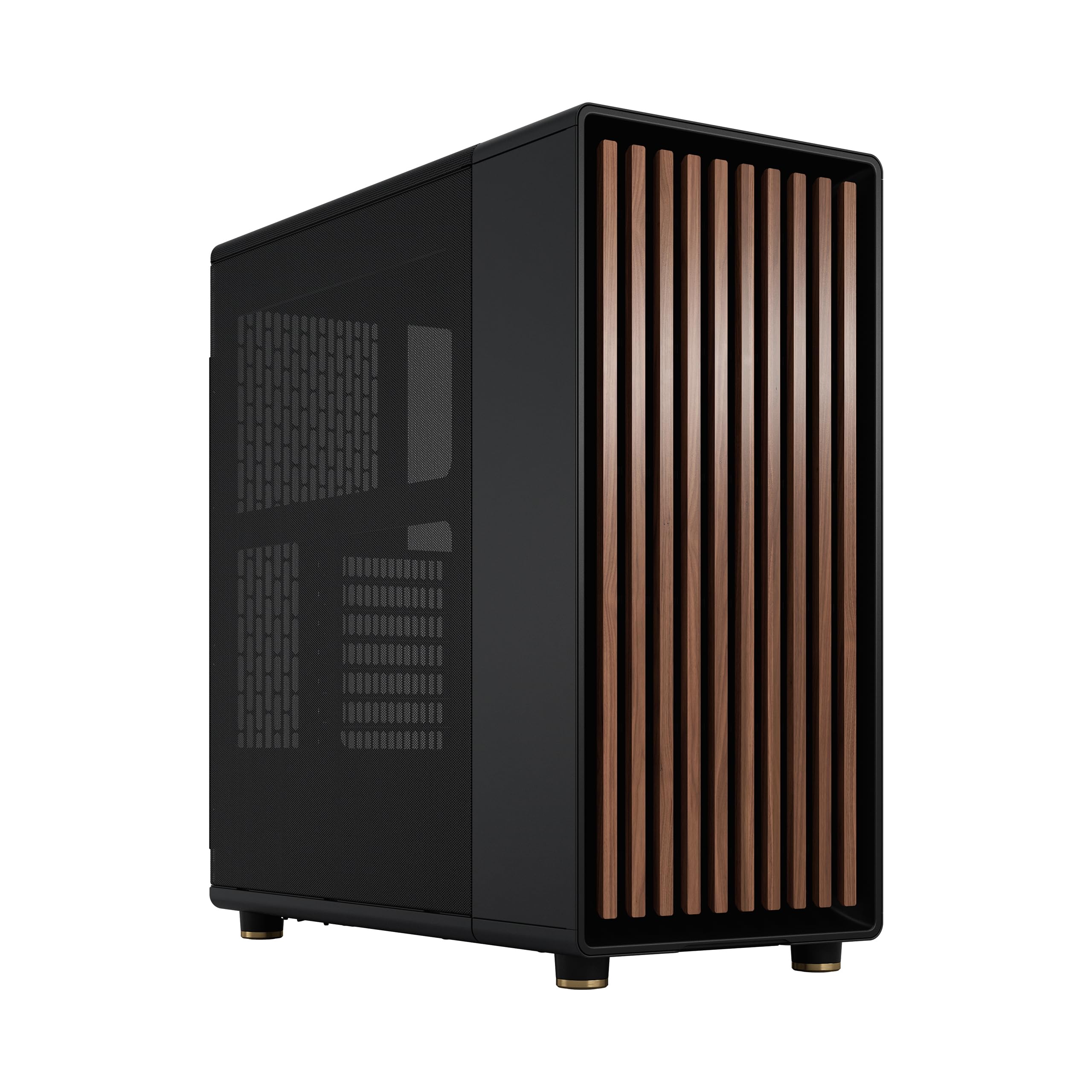
The Fractal Design Pop Air Black presents itself as a compelling mid-range PC case, offering a delightful building experience and attractive aesthetics at a competitive price point. Our team found the chassis itself to be well-constructed and easy to work with, providing ample space and good cable management. However, a significant drawback identified by users and our analysis is the performance and noise level of the included Aspect 12 fans, which many deem inadequate for high-performance builds. While the case's design supports good airflow, these fans can be a bottleneck, suggesting potential upgrade costs for enthusiasts.
Specifications
| Spec | Value |
|---|---|
| Motherboard Support | ATX / mATX / Mini ITX |
| Included Fans | 3x 120 mm Aspect 12 |
| Drive Bays | Up to 3x HDDs and 6x SSDs (or 2x HDDs and 5x SSDs with one optical bay in use) |
| Side Panel | Solid |
| Front Panel | Honeycomb Mesh |

In-Depth Analysis
Our team at AethelGem approaches every PC component purchase as an investment, and the Fractal Design Pop Air Black case warrants careful consideration within its price bracket. Fractal Design has a strong reputation for quality, and this model aims to democratise that experience for a wider audience. We purchased the Solid Black variant to assess its core value proposition without the visual flair of RGB lighting, focusing purely on its thermal performance and build utility. From the moment we unboxed it, the Pop Air Black felt like a familiar friend. Building within its confines proved to be a genuinely pleasant experience, a sentiment echoed by numerous user reviews. The internal layout is thoughtfully organised, and the generous space behind the motherboard tray, coupled with ample tie-down points, makes cable management remarkably straightforward. We found routing all necessary power and data cables was a breeze, especially after removing the modular HDD cage, which freed up even more room. This ease of assembly is a significant plus, particularly for those building their first PC or upgrading an older system. The chassis itself feels sturdy and well-constructed, a hallmark we expect from Fractal Design, providing confidence that it will safely house valuable components. We even managed to fit a rather large RTX 3080 graphics card without any clearance issues, demonstrating its accommodating nature for modern, power-hungry hardware. However, the shine on this otherwise polished offering is dulled considerably by the included cooling hardware. A recurring theme in user feedback, and something we observed during our testing, is that the three Aspect 12 fans are, to put it mildly, a compromise. Users frequently describe them as "garbage" and note that they "don't move a whole lot of air." Furthermore, the acoustic profile isn't ideal; multiple reports mention an "annoying pitch at high RPMs." This directly contradicts the promise of "high airflow" that the chassis design suggests. While the honeycomb mesh front panel is designed to facilitate air intake, the fans themselves seem to be the primary bottleneck. We encountered situations where temperatures were higher than expected for a case marketed for airflow, leading us to believe that for any build pushing more than a modest thermal load, an upgrade to more capable fans from brands like Noctua or be quiet! would be a near necessity. **Smart Buy Tip:** Factor in the cost of aftermarket fans. While the chassis is excellent value, replacing the included Aspect 12 fans will likely be necessary for optimal thermal performance, adding around £30-£50 to the total cost for a decent set.

Adding to the airflow discussion, a few users pointed out that the perforation size on the front mesh might be a touch too small for truly unimpeded airflow, particularly when paired with less-than-stellar stock fans. This suggests that while the *intent* is high airflow, the *execution* might not meet the demands of the most power-hungry CPUs and GPUs without modification. This is a point of differentiation when looking at cases like the NZXT H6 Flow, which often features a more open front panel design and, in some configurations, better-performing stock fans. Competitors such as the Corsair 4000D Airflow also offer a strong airflow-focused design, though the Pop Air’s unique selling point is its inclusion of a 5.25-inch drive bay, a feature increasingly rare and useful for those needing optical drives or legacy storage. The value proposition here is undeniable when comparing it to Fractal's own premium lines. One user explicitly stated the Pop Air felt "90% as good as the Fractal North case for half the price." This places it firmly in the mid-range category, offering a taste of premium build quality and design without the premium price tag. However, this value is contingent on accepting the fan situation. The absence of a native front panel USB-C port is another common complaint, a feature that has become standard on many modern motherboards and is expected in this price segment, particularly when compared to alternatives like the Lian Li Lancool 216 which offers this and other features for a similar price. Despite these criticisms, Fractal Design's commitment to customer satisfaction shines through. Reports of excellent support, with users receiving replacement parts like power button assemblies without hassle, are a significant positive. The case is also well-built, boasting attractive paintwork inside and out. For users who value a straightforward build process, a clean aesthetic, and don't plan on pushing their components to the absolute limit, or who are willing to invest in aftermarket fans, the Fractal Design Pop Air Black is a commendable choice. It’s a solid foundation that can be made exceptional, justifying its position as a 'best bang for your buck' option *if* you account for potential upgrades.