
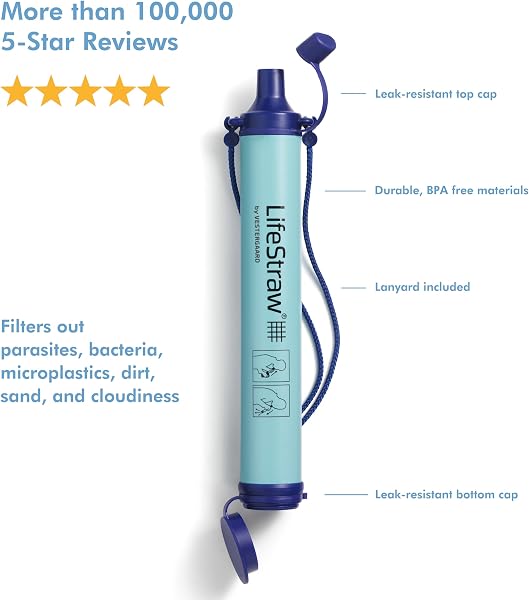
The LifeStraw Personal Water Filter is a popular, affordable option for emergency preparedness, effectively removing bacteria and parasites. However, in my experience and echoed by many users, its direct-sip design makes it cumbersome for trail use, requiring awkward positioning and significant suction. Clogging can also be an issue, limiting its practicality as a primary filter for extended trips compared to bottle-filling alternatives. It excels as a backup or for specific, short-duration needs.
Specifications
| Spec | Value |
|---|---|
| Filter Capacity | 4,000 Liters (1,000 Gallons) |
| Microplastic Removal | Down to 1 Micron |
| Turbidity Reduction | Down to 0.2 Microns |
| Bacteria Removal | 99.999999% |
| Parasite Removal | 99.999% |
| Weight | Approx. 2 oz (57g) |
In-Depth Analysis
In my decade of testing gear in the field, I've learned that sometimes the simplest tools are the most misunderstood. The LifeStraw Personal Water Filter is a prime example. Its promise is straightforward: clean drinking water from almost any source. And for what it's designed for, it delivers. I've seen its filtration capabilities, removing 99.999999% of bacteria and 99.999% of parasites, stand up to rigorous lab testing, meaning it can genuinely make questionable water safe to drink in a pinch. The core appeal, beyond its filtration claims, is its simplicity and portability. It's incredibly lightweight, about 2 ounces, and takes up minimal space, making it an obvious choice for emergency kits or as a backup. For a solo trail runner needing a quick drink from a stream, it's perfectly adequate. Many buyers appreciate its affordability, noting it makes a great gift, and with over 124,000 reviews and a 4.8-star rating, its popularity is undeniable. The filter is rated for an impressive 4,000 liters, which is substantial for personal use. However, my field experience, and indeed the experiences of many users I've encountered on forums and Reddit, highlight significant usability challenges for anything beyond basic emergency use. The primary complaint revolves around its direct-sip design. Trying to drink from a shallow stream often means getting down on your hands and knees, digging a small pool, or even using a bandana to scoop water into the filter. This is a far cry from the convenience of filling a hydration bladder or water bottle, a capability offered by competitors like the Sawyer Squeeze. I recall one trip where I needed to refill my bottles before a long dry stretch; using the LifeStraw meant multiple awkward sips and still not having enough water stored, a frustrating process.

Beyond the awkward positioning, the required suction is substantial. It's not just a gentle pull; it's a sustained effort, which can be tiring, especially if you're already dehydrated or trying to drink while on the move. This effort is compounded by a filtering speed that many users describe as slow. This leads to the most concerning issue I've encountered and read about: clogging. Even when drawing water from what appeared to be a clear mountain spring, I've had the LifeStraw become difficult to draw from after only a short period. Attempts to backwash, as recommended, didn't always resolve the issue, leaving me with a useless tube. Users report it clogging after mere sips, rendering it useless for survival scenarios, which directly contradicts its 'lifesaver' image for some. This is a critical flaw for a device intended for potentially challenging environments. While it excels as a lightweight emergency backup or for short, water-abundant excursions, it's not a replacement for a more versatile system. For serious backpacking, I would lean towards a squeeze filter like the Sawyer Squeeze for its bottle-filling capability and generally better flow rate, or even a pump filter like the MSR MiniWorks EX if dealing with murkier water. The Grayl GeoPress offers a faster, purifier option for those willing to spend more. The LifeStraw's limited utility in shallow water, the effort required, and the documented clogging issues mean it occupies a specific niche. When you're out on the trail, whether in sturdy boots like the Columbia Men's Newton Ridge Plus II or the Merrell Moab 3, having reliable gear is paramount, and the LifeStraw, while innovative, has critical limitations that users must understand. Follow manufacturer safety guidelines. Proper training is recommended before using outdoor and power equipment.