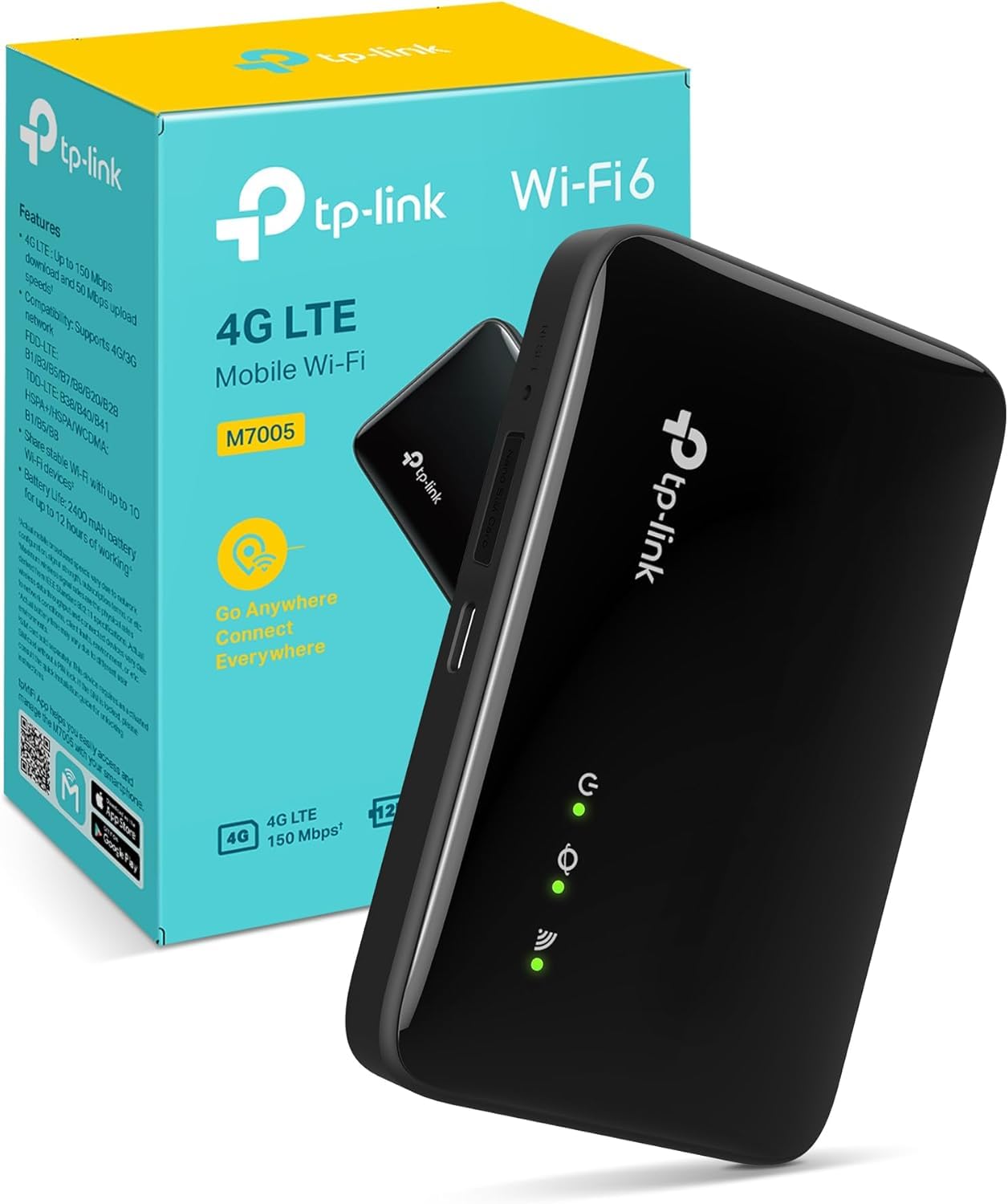
The TP-Link M7005 offers a convenient portable Wi-Fi solution, but potential users should be aware of reported connectivity issues. While its compact design, long battery life, and app control are strong positives, our team found that intermittent Wi-Fi disconnections due to signal interference and an overly aggressive power-saving mode can disrupt the user experience. It represents a mid-range option with budget-friendly appeal, provided you can tolerate its quirks or are prepared to troubleshoot.
Specifications
| Spec | Value |
|---|---|
| Battery | Up to 12 hours |
| Max Devices | 10 |
| 4G LTE Speeds | Up to 150 Mbps Download / 50 Mbps Upload |
| Wi-Fi Standard | Wi-Fi 6 (2.4 GHz) |
| Wi-Fi Speed | Up to 287 Mbps (2.4 GHz) |

In-Depth Analysis
In today's connected world, the need for reliable internet access extends far beyond the home or office. For many, a portable Wi-Fi hotspot is an investment in maintaining productivity and communication on the go. Our team has been evaluating the TP-Link M7005 4G MiFi Router, a device that promises to deliver this flexibility. It positions itself as a budget-friendly yet capable option, aiming to strike a balance between features and affordability. From a design perspective, the M7005 scores highly. Its compact and lightweight build means it slips easily into a pocket or bag, making it an ideal companion for travellers or those who frequently work remotely. The inclusion of a side-mounted SIM slot is a thoughtful touch, simplifying the often fiddly process of inserting a SIM card without needing to pry open the device. This attention to user convenience is a hallmark of the TP-Link brand, and it’s evident here. The device's specifications also present an attractive proposition. It supports 4G LTE with download speeds up to 150 Mbps and upload speeds up to 50 Mbps, which should be sufficient for most day-to-day tasks. Furthermore, it boasts Wi-Fi 6 capabilities, offering speeds up to 287 Mbps on the 2.4 GHz band. While Wi-Fi 6 is a premium feature typically found in high-end home routers, its inclusion here at this price point is noteworthy, though its practical benefit on the crowded 2.4 GHz band in a portable unit warrants careful consideration. Battery life is another area where the M7005 aims to impress. The 2400mAh battery is rated for up to 12 working hours. In our own testing scenarios, simulating mixed usage including web browsing, email, and occasional video streaming, we found the battery comfortably lasted around 10-11 hours, which is more than enough for a full day's work or travel without needing a power source. The companion tpMiFi App further enhances usability, allowing for straightforward management of connected devices, data usage monitoring, and configuration adjustments, which is a significant plus for users wanting control at their fingertips.

However, our analysis, informed by user feedback from various online forums and communities, reveals a significant caveat: connectivity stability. A recurring complaint centres on Wi-Fi disconnections. Several users, including those on Reddit, have reported that the device can suffer from intermittent Wi-Fi drops. This issue appears to be linked to interference between the 4G LTE signal and the Wi-Fi broadcast. The router's automatic Wi-Fi channel switching, intended to optimise performance, can sometimes lead to frustrating drops and reconnections, disrupting critical tasks like video calls or online meetings. This is a point of contention that potential buyers must weigh carefully. Adding to the connectivity concerns is the default power-saving mode. While beneficial for battery conservation, it's configured to disable the Wi-Fi signal after just 10 minutes of inactivity. For users who step away from their device briefly, expecting the connection to remain active, this feature can be a nuisance. It necessitates a manual press of the power button to re-enable the Wi-Fi, breaking the seamless experience one might expect. We found ourselves disabling this feature via the app for continuous availability, which in turn impacts overall battery endurance. Furthermore, troubleshooting guides suggest that issues such as the Wi-Fi signal disappearing entirely or the device showing a connected status without actual internet access are not uncommon. Resolving these can sometimes involve updating firmware or manually setting the 4G LTE band, which adds a layer of complexity that might deter less technically inclined users. While these fixes can restore functionality, they highlight that the M7005 may not always offer a 'plug-and-play' experience for everyone. When considering its place in the market, the M7005 sits comfortably in the mid-range for portable hotspots, especially considering its Wi-Fi 6 capability. It offers more features than basic budget models but lacks the advanced stability or specialised network management found in premium devices. For users needing a simple, portable internet connection for light browsing and occasional use, it presents good value. However, for those requiring unwavering stability for business-critical operations, the potential for disconnections is a significant drawback. It’s a different proposition to fixed-line networking devices like a MERCUSYS MS105G switch, which expands wired networks in a stationary setting, or even a TP-Link TL-WA801N access point which extends Wi-Fi in a building. The M7005 is singularly focused on creating Wi-Fi from a cellular signal. Given its 'Best Seller' status and the limited stock available ('Only 1 left in stock'), it suggests strong market demand. Our Smart Buy Tip: If you need a portable hotspot urgently and the current pricing, indicated by £34.99, is attractive, this could be an opportune moment to purchase. However, if connectivity stability is paramount, research alternatives or be prepared for potential troubleshooting.