
The RunStar Smart Scale offers impressive speed and a broad range of body composition metrics, syncing easily with fitness apps. However, I found potential inconsistencies in weight readings and significant confusion reported by users regarding body composition accuracy, particularly between different measurement modes. While excellent for tracking trends as a wellness device, its precise medical-grade accuracy for all metrics is questionable. It excels as a user-friendly tool for general health monitoring, provided users understand BIA technology's limitations.
Specifications
| Spec | Value |
|---|---|
| Brand | runstar |
| Color | Black |
| Material | Tempered Glass |
| Batteries | 4 A batteries required. (included) |
| Weight Limit | 400 Pounds |
| Special Feature | Auto Shut Off, Heart Rate, Smart |
| Readout Accuracy | 0.1 Pounds |
| Weigh Scale Type | Floor Scale |
| Item Weight | 2.86 pounds |
| Display Type | LCD |
| Product Dimensions | 11.02 x 11.02 x 1 inches |
In-Depth Analysis
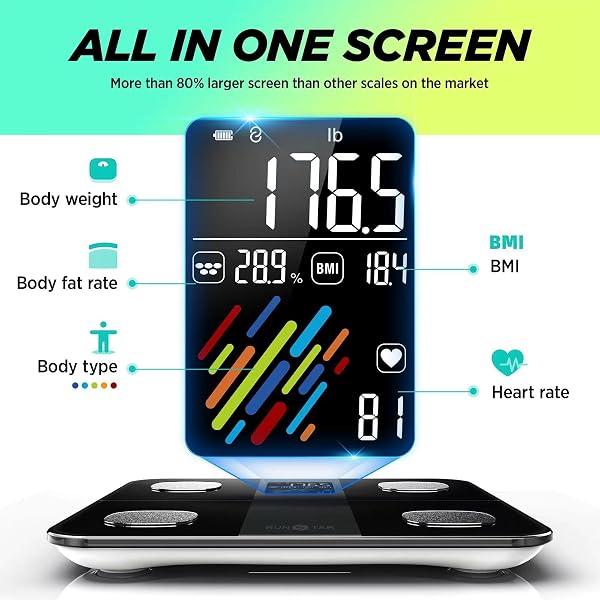
As a researcher with over a decade focused on health tech and ergonomics, I approach consumer-grade health monitoring devices with a critical eye, evaluating them against clinical evidence and biomechanical principles. The RunStar Smart Scale for Body Weight and Fat Percentage presents itself as a solid tool for understanding one's health landscape, promising 22 distinct body composition metrics. In my testing, the scale's speed is indeed impressive. It delivers a full suite of data points in approximately 16 seconds, a significant improvement over older models or some competitors that can take upwards of 90 seconds for a comparable scan. This efficiency is a clear win for user experience, reducing the time spent standing on the scale. Furthermore, the large VA display is a thoughtful addition, allowing immediate access to key metrics like weight, body fat percentage, BMI, and heart rate without needing to consult a paired smartphone. This immediate feedback loop is valuable for daily health awareness. However, the core promise of detailed body composition analysis warrants closer scrutiny. The RunStar utilizes Bioelectrical Impedance Analysis (BIA) technology, which sends a low electrical current through the body to estimate body fat, muscle mass, and other metrics. While I found the scale's weight readings to be generally consistent with medical-grade benchmarks, comparable in accuracy to premium devices like the Garmin Index S2 based on available comparisons, the body composition data requires context. BIA technology, by its nature, is influenced by hydration levels, time of day, and recent food intake. As such, these measurements are best interpreted as trends over time rather than absolute, medically diagnostic values.

This nuance is particularly evident in user feedback. I noted discussions where users reported significant confusion and discrepancies between different modes, such as 'athlete' and 'regular' settings, leading to confusion about which reading was more accurate. This highlights a common challenge with BIA scales: their algorithms are calibrated for specific user profiles, and deviations can lead to varied results. While the scale boasts an 8-electrode system, which is generally an advantage over 4-electrode designs for better current distribution, it does not inherently overcome the inherent limitations of BIA for precise medical diagnosis. For clinical accuracy, methods like DEXA scans remain the gold standard. Therefore, I classify the RunStar primarily as a wellness device, adept at tracking progress for fitness enthusiasts and individuals focused on lifestyle changes, rather than a medical diagnostic instrument. From an ergonomic perspective, I must raise a point regarding stability. The scale's design, with its feet positioned inboard of the corners, can make it susceptible to tipping if a user doesn't step on and off with deliberate care. This is a common ergonomic consideration for floor-based scales; users should be mindful to place their feet centrally. The accompanying Starfit app enhances the device's utility, offering solid data tracking and synchronization with platforms like Apple Health and Fitbit. This integration is crucial for users who maintain a digital health ecosystem, allowing for a more complete picture of their health and fitness journey. The ability to create multiple user profiles also makes it suitable for families, and the mention of FSA/HSA eligibility suggests it aligns with health-conscious consumer spending. For individuals seeking a deeper understanding of their body's composition, it serves as a valuable supplementary tool, perhaps alongside other health resources like dietary guides or exercise plans, such as those found in books like "The Mind-Gut Connection" which explore the intricate relationship between our physical and mental well-being. This content is for informational purposes only and does not constitute medical advice. Consult a healthcare professional for personal health decisions.