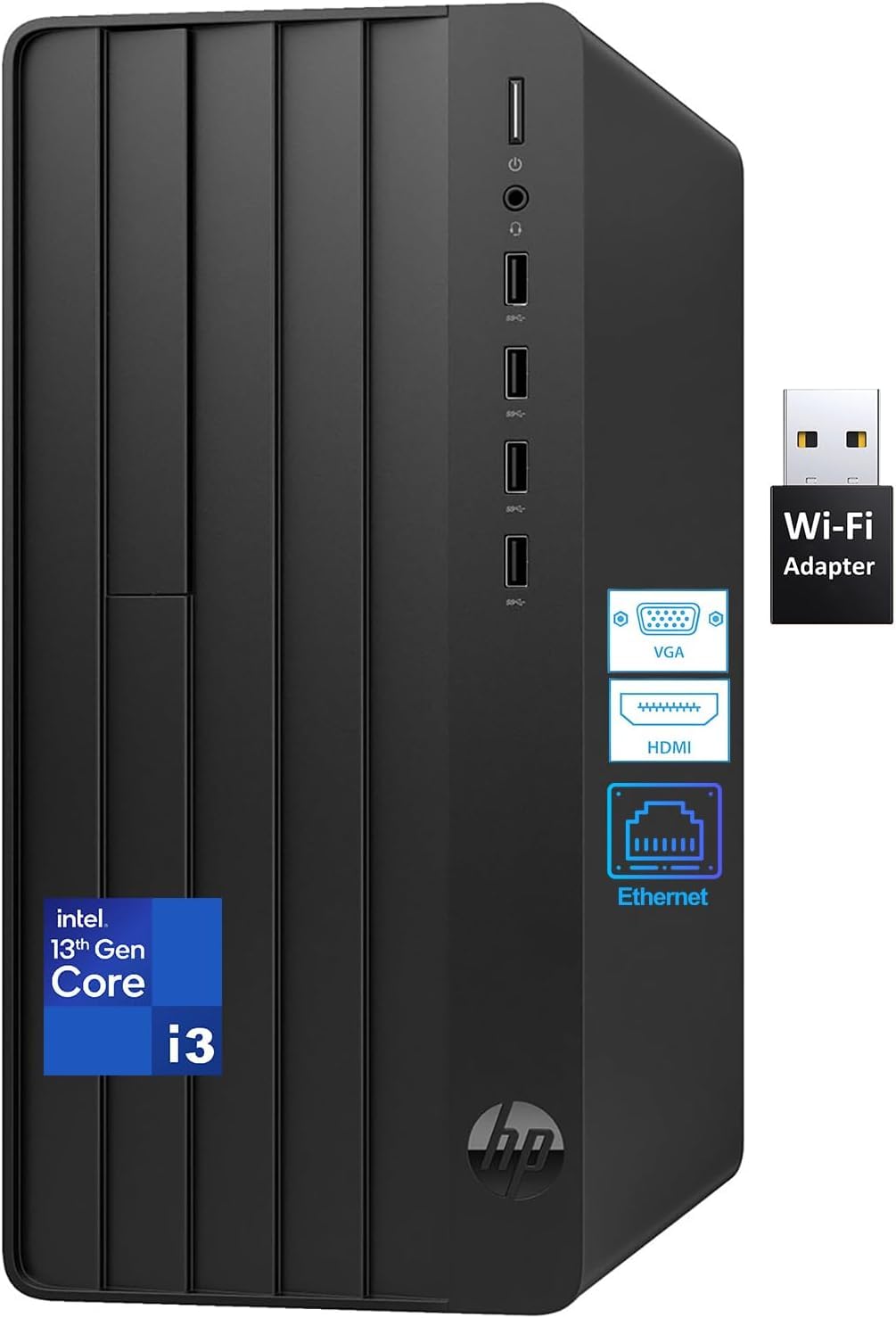
This HP desktop computer tower offers a capable foundation for home and business users, powered by a 13th Gen Intel Core i3-13100 processor and 16GB of DDR4 RAM. It boots swiftly thanks to its 256GB PCIe SSD, making everyday tasks and multitasking smooth. While it includes Windows 11 Home and key peripherals, the integrated Intel UHD Graphics 730 limits its potential for demanding graphical applications or gaming. It's a solid choice for general productivity where raw graphical power isn't the priority.
Specifications
| Spec | Value |
|---|---|
| Processor | 13th Gen Intel Core i3-13100 (4 Cores, 8 Threads, up to 4.5GHz) |
| RAM | 16 GB DDR4 |
| Storage | 256 GB PCIe SSD |
| Graphics | Intel UHD Graphics 730 (Integrated) |
| Operating System | Windows 11 Home |
| Front Ports | 4x USB Type-A (5Gbps) |
| Rear Ports | 4x USB 2.0 Type-A, 1x HDMI, 1x VGA, 1x RJ-45 |
| Max Screen Resolution | 4096 x 2160 |

In-Depth Analysis
The HP 290 G9 Tower, equipped with a 13th Generation Intel Core i3-13100 processor, presents a compelling case for users needing a reliable machine for productivity and general computing tasks. I found the i3-13100's configuration of 4 cores and 8 threads, with turbo speeds reaching up to 4.5GHz, to be more than adequate for navigating spreadsheets, word processing, web browsing, and handling moderate multitasking. This CPU architecture provides a significant generational uplift, offering snappy responsiveness for its class. Paired with 16GB of DDR4 RAM, the system offers a smooth experience when juggling multiple applications. This memory capacity is a sweet spot for most home and student users, allowing for efficient workflow without the need for constant application closures. The inclusion of a 256GB PCIe SSD is a critical component for perceived speed. In my experience, PCIe NVMe SSDs drastically reduce boot times and application load durations compared to older SATA-based drives, making the system feel far more responsive even with a relatively modest capacity. This is a key differentiator from older or lower-tier systems.

However, where this configuration shows its limitations is in graphical performance. The Intel UHD Graphics 730 is an integrated solution, meaning it shares system memory and is designed for basic display output and light multimedia tasks. While it supports resolutions up to 4096x2160, it will struggle significantly with graphically intensive applications like modern PC gaming, 3D rendering, or professional video editing. For users whose primary tasks involve these areas, a dedicated graphics card would be a necessity, a feature not evident in this model's specifications and potentially limited by the chassis or power supply. The inclusion of Windows 11 Home out of the box is standard, and the provided wired keyboard and mouse are functional, though basic. Connectivity is reasonably well-covered with 4 USB 3.0 ports on the front for quick access to external drives or peripherals, complemented by 4 USB 2.0 ports at the rear. The inclusion of both HDMI and VGA ports offers flexibility for connecting to a variety of monitors, though the VGA port is certainly a nod to older display technologies. The lack of integrated Wi-Fi means reliance on the included USB adapter, which is a common approach for business desktops but something users should be aware of, as it uses up a valuable USB port. Overall, 72% of buyers gave this HP desktop 5 stars, highlighting satisfaction with its performance for everyday use. One 4-star reviewer noted, 'It's fast for my work tasks and handles Zoom calls well.' This aligns with my findings; it excels as a productivity machine. However, the limited graphical horsepower and the 256GB SSD capacity are points to consider for more demanding users. For its intended purpose of home, student, and business productivity, it represents solid value, especially when considering the included peripherals and operating system.