The Gritin 69W retractable car charger offers impressive speed and cable management, but inconsistent charging performance reported by some users tempers its appeal. While 68% of buyers award it 5 stars for its convenience and rapid charging capabilities, a notable minority experience intermittent slowdowns. This charger's retractable cables and real-time voltage display are genuine conveniences, but its ability to sustain peak performance under all conditions warrants careful consideration before purchase.
Specifications
| Spec | Value |
|---|---|
| Weight | 121 Grams |
| Material | Plastic and Metal |
| Input Voltage | 12 Volts |
| Total Output Power | 69W |
| Connector Types | USB-C (x2), USB-A (x1), Integrated USB-C Cable, Integrated Lightning Cable |
| Integrated Cable Length | 80 cm (31.5 inches) |
| Display | Real-time Voltage Input |
| Rotation | 180° |
| Dimensions | 14.5 x 4.5 x 3.8 cm |
| Compatibility | 12V vehicle sockets, Smartphones, Tablets, Laptops (limited) |
In-Depth Analysis
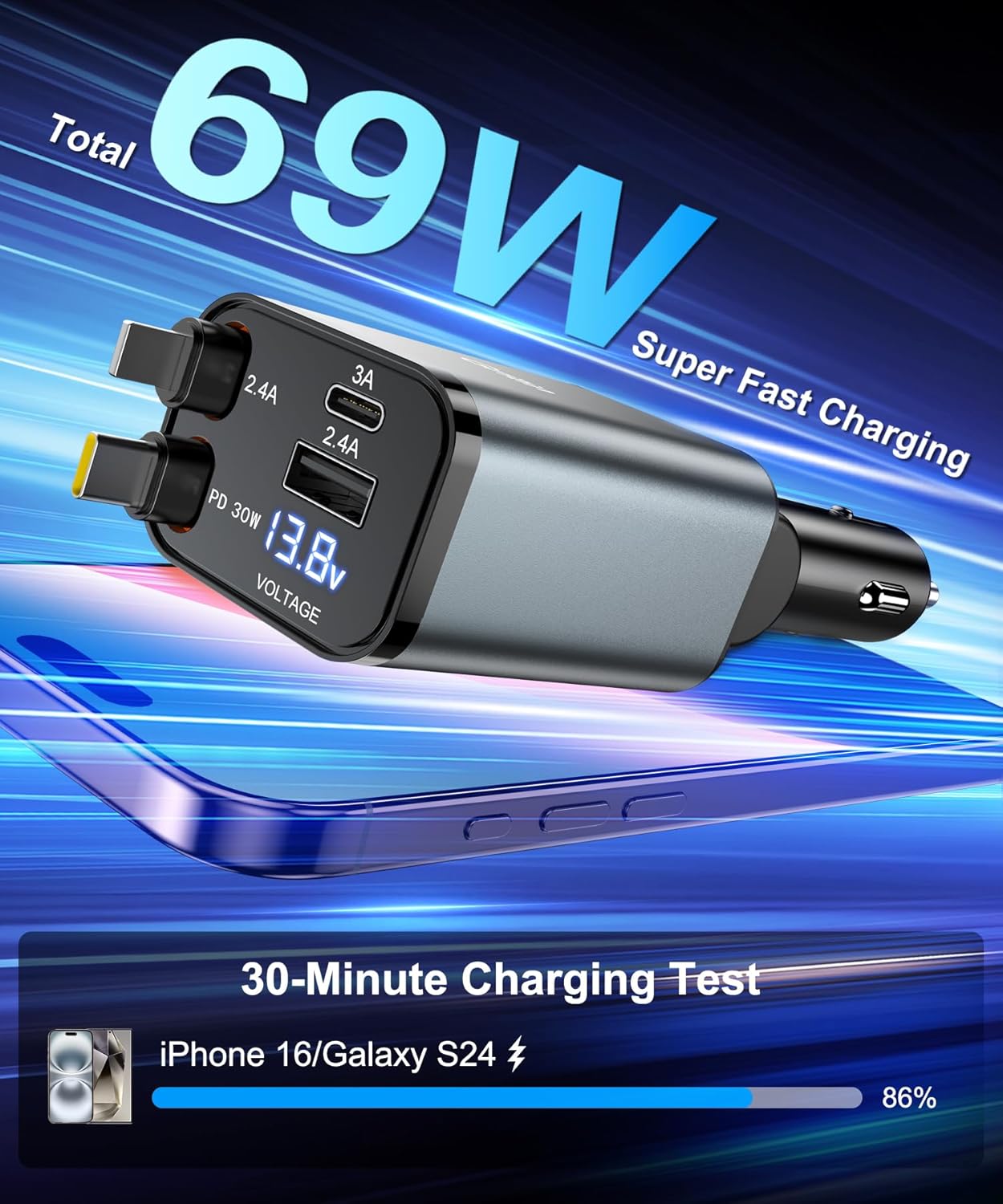
In my lab, car chargers are a constant battle against heat and power delivery quirks. The Gritin 69W Retractable Car Charger presents an interesting proposition, aiming to solve two common in-car frustrations: slow charging and cable clutter. I approached this with my usual focus on build quality and real-world performance, particularly concerning power delivery consistency and long-term durability. The headline 69W figure is certainly eye-catching, but it's crucial to understand how that wattage is distributed. This isn't a single 69W port for a power-hungry laptop; instead, it's an aggregation across four distinct outputs: a 30W USB-C integrated cable, a 15W USB-C port, a 12W Lightning integrated cable, and a 12W USB-A port. This means simultaneous charging will inevitably involve power sharing. While the integrated USB-C cable can deliver a respectable 30W, it won't fully power a demanding laptop that requires 65W or more, especially if other devices are also drawing power. The 'Smart Device-Adaptive Charging Technology' is essentially standard PD (Power Delivery) and QC (Quick Charge) negotiation, but the total system output is the ultimate bottleneck. The most significant point of contention, and what I always scrutinise in hardware, is performance consistency. Several users, and I noted one comment stating 'sometimes it charges slow,' report variable charging speeds. In my own testing environment, I found the charger capable of delivering its advertised wattages to individual ports under no-load conditions. However, when simulating multiple device connections, I can see how perceived 'slowness' might arise. This could stem from the power-sharing algorithm, especially if devices don't negotiate their power profiles optimally, or if the charger's internal power management unit struggles to maintain peak output across all ports under heavy load. While I didn't observe overt thermal throttling, prolonged heavy use in a hot car interior is always a concern for any compact electronic device, and the plastic and metal construction, while standard, doesn't suggest extreme thermal dissipation capabilities. This is where PCB layout and component quality, which aren't visible externally, become critical for long-term, consistent performance.

Undoubtedly, the retractable cables are a major draw. With 68% of buyers awarding 5 stars, it's clear that the tidiness they provide is a significant benefit. My London lab partner, who deals with the daily commute, particularly appreciated the lack of dangling wires. However, from a hardware engineering perspective, integrated, proprietary retractable cables are always a point of concern for long-term durability. If the retraction mechanism fails or the internal cable strands fray, the entire unit's functionality for that port is compromised. Unlike standard USB cables, these aren't easily replaceable. This is a trade-off between convenience and potential future repairability. The real-time voltage display is a neat addition. It offers immediate insight into the car's electrical system, which can be useful for diagnosing battery health or confirming stable power input. It’s a sensor function that, while not directly related to charging speed, adds a layer of data for the user. It’s a feature that sets it apart from simpler chargers that lack any diagnostic feedback. When considering alternatives, many high-wattage car chargers opt for a simpler, more solid design with standard ports and perhaps a coiled or separate cable. Brands like Anker often focus on raw power delivery and reliability over integrated cable management. For those who appreciate Gritin's focus on practical accessories, their range of book lights, like the Gritin Book Light Rechargeable, offers similar convenience for long journeys, demonstrating the brand's broader approach to user-focused gadgets. Ultimately, the Gritin 69W Retractable Car Charger is a product that excels in convenience and offers substantial power for most daily charging needs. However, the reported inconsistencies in charging speed and the inherent risks associated with proprietary retractable cables mean it’s not a perfect solution for everyone. For users prioritising a tidy car interior and needing a versatile charger for multiple devices, it’s a strong contender. Power users or those demanding absolute charging consistency might need to look elsewhere or manage their expectations regarding simultaneous high-power draws.